Notas sobre especies de aves que siguen legiones de hormigas en los Andes colombianos
DOI:
https://doi.org/10.59517/oc.e585Keywords:
Antpittas, army ants, behavior, diet, Río Blanco ReserveAbstract
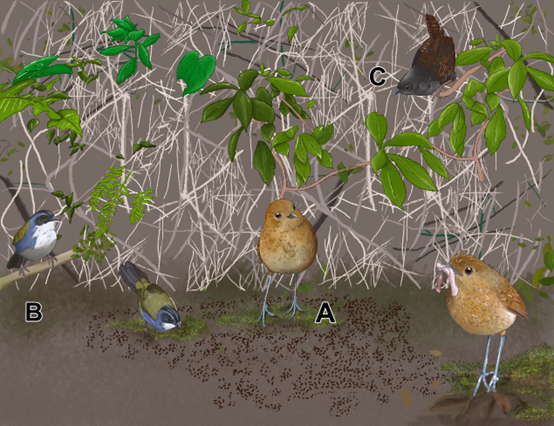
Several bird species follow legions of ants in order to feed on the arthropod fauna that flees from these swarms. Most of these birds are opportunistic, while a few are obligate or specialist followers. These interactions between ant swarms and birds have been widely documented in lowland tropical areas, but in the highlands of the Neotropics, this phenomenon is poorly understood. In this note, we present the analysis of an interaction event between a group of birds (Grallaria milleri, Arremon assimilis, Scytalopus spillmanni) and an ant swarm possibly of the genus Neivamyrmex, in the Río Blanco Reserve (Manizales-Caldas). This is the first report of S. spillmanni and the second of G. milleri and A. assimilis following an ant swarm, in addition, we include a review of other reports of birds following legionary ants in the Colombian Andes.
Downloads
References
BirdLife International. 2022. Important Bird Areas factsheet: Reserva Hidrográfica, Forestal y Parque Ecológico de Río Blanco. Downloaded from http://www.birdlife.org on 25/11/2022
Brady, S.G., B.L. Fisher, T.R. Schultz & P.S. Ward. 2014. The rise of the army ants and their relatives: diversification of specialized predatory doryline ants. BMC Evolutionary Biology 14(1):1-14. https://doi.org/10.1186/1471-2148-14-93
Chaves-Campos, J. 2012. ¿Cómo localizan las aves a las hormigas arrieras Eciton burchellii?: El caso del seguidor obligatorio de hormigas arrieras Phaenostictus mcleannani (Ocellated Antbird). Zeledonia 16(2):3-20. https://www.zeledonia.com/uploads/7/0/1/0/70104897/16-2-004-chavez-campos.pdf
Dunning, J.B. 2008. CRC Handbook of Avian Body Masses, second edition. CRC Press, Taylor & Francis Group, Miami, FLA y New York, NY (EEUU) y Oxford, UK. https://www.routledge.com/CRC-Handbook-of-Avian-Body-Masses/Jr/p/book/9781420064445
Faria, C. & M. Rodrigues. 2009. Birds and army ants in a fragment of the Atlantic Forest of Brazil. Journal of Field Ornithology 80(4):328-335. https://www.jstor.org/stable/40983710
Fernández, F. 2003. Introducción a las Hormigas de la región Neotropical. Instituto de Investigación de Recursos Biológicos Alexander Von Humboldt, Bogotá, D. C.
Gochfeld, M. & G. Tudor. 1978. Ant-following Birds in South American Subtropical Forests. The Wilson Bulletin 90(1):139-141. https://www.jstor.org/stable/4161035
Gotwald, Jr, W.H. 1995. Army Ants, the biology of social predation. Cornell University Press, Ithaca, Nueva York.
Hilty, S.L. 1974. Notes on Birds at Swarms of Army Ants in the Highlands of Colombia. The Wilson Bulletin 86(4):479-481. https://sora.unm.edu/sites/default/files/journals/wilson/v086n04/p0479-p0481.pdf
Hilty, S.L. & W.L. Brown. 2001. Guía de las aves de Colombia. Princeton University Press, American Bird Conservancy-ABC, Universidad del Valle, Sociedad Antioqueña de Ornitología-SAO, Cali. 1030 pp
Holdridge, L.R. 1967. Life zone ecology. Tropical Science Center. San José, Costa Rica.
Krabbe, N. XC242126. Accesible en www.xeno-canto.org/242126
Nieto, M. & J.D. Ramírez. 2006. Notas sobre aves de tierras altas que siguen marchas de hormigas arrieras para su alimentación, en la reserva natural Río Blanco, Manizales, Caldas. Boletín SAO, 16:59-66. https://sao.org.co/publicaciones/boletinsao/08Nieto&RamirezGrallarias-Buarremon.pdf
O'donnell, S., A. Kumar & C. Logan. 2010. Army ant raid attendance and bivouac-checking behavior by neotropical montane forest birds. The Wilson Journal of Ornithology 122(3):503–512. https://api.repository.cam.ac.uk/server/api/core/bitstreams/f1524241-c02b-4332-aa56-6fe562eb9eac/content
Palacio, E. 1999. Hormigas legionarias (Hymenoptera: Formicidae: Ecitoninae) de Colombia. Páginas 117-189 en: Amat, G., G. Andrade & F. Fernández. (eds). Insectos de Colombia. Volumen II. Academia Colombiana de Ciencias Exactas, Físicas y Naturales. Santa Fé de Bogotá.
Palacio, E.E. 2019. Subfamilia Dorylinae. Capítulo 19, páginas 571-630 en: Fernández, F., R. J. Guerrero & R. T. Delsine (2019). Las Hormigas de Colombia. Universidad Nacional de Colombia, Facultad de Ciencias, Instituto de Ciencias Naturales, Bogotá, Colombia.
Ríos, M., G. Londoño & L. Biancucci. 2008. Notes on birds that follow army ants in the Northern Andes. Ornitologia Neotropical 19:137–142. https://citeseerx.ist.psu.edu/document?repid=rep1&type=pdf&doi=1be9f489f84098a56cf3aaebf2fa63c408e32754
Ríos M. & M.C. Muñoz. 2014. Penelope perspicax, en: Renjifo ,L. M., Gómez, M. F., Velásquez-Tibatá, J., Kattan, G. H., Amaya-Espinel, J. D., Amaya-Villarreal, A. M. y Burbano-Girón, J. (eds.). Libro Rojo de Aves de Colombia. Volumen I: Bosques Húmedos de los Andes y la costa Pacífica. (Pp. 77-83.). Editorial Pontificia Universidad Javeriana e Instituto Alexander von Humboldt.
Willis, E.O. & Y. Oniki. 1978. Birds and army ants. Annual Review of Eology and Systematics 9:243-263. https://www.jstor.org/stable/2096750
Willson, S.K. 2004. Obligate Army ant following Birds: A Study of Ecology, Spatial Movement Patterns and Behavior in Amazonian Peru. Ornithological Monographs 55:1-67. https://sora.unm.edu/sites/default/files/journals/om/om055.pdf
Downloads
Additional Files
Published
Issue
Section
License
Copyright (c) 2026 Los Autores. Revista Ornitología Colombiana, Asociación Colombiana de Ornitología ACO

This work is licensed under a Creative Commons Attribution-NonCommercial 4.0 International License.